A ceramic glass coating is a thin functional surface layer applied to glass or glass-ceramic to change cleanability, wetting, appearance, scratch response, or chemical resistance. It is not a substitute for selecting the correct substrate. Appliance buyers should specify the substrate, coating function, application side, cured condition, and verification method together.
This guide explains the main decisions buyers, engineers, and service teams should document before selecting or ordering ceramic glass coating.
The phrase covers several different systems. Sol-gel and silica-rich coatings may increase water repellency or ease cleaning. Printed ceramic inks create durable color, borders, symbols, or masking. Other layers are designed for optical, anti-reflective, conductive, or protective functions.
Start the specification with the required result rather than the word coating. A buyer who asks only for a ceramic coating may receive quotes for products that solve completely different problems.
Coating performance depends on surface chemistry, flatness, roughness, thermal expansion, and the panel’s later heat cycle. Tempered soda-lime glass, borosilicate glass, and glass-ceramic do not share the same processing window.
For cooktops and heated appliance panels, confirm whether printing or coating occurs before or after strengthening, ceramization, bending, or edge finishing. The sequence can affect adhesion, color, and final dimensions.
Translate marketing terms such as easy-clean, hydrophobic, or scratch resistant into measurable acceptance criteria. Useful fields include initial water contact angle, abrasion cycles, chemical exposure, color difference, haze, adhesion, and performance after thermal cycling.
Spray, dip, flow, roll, screen print, and physical deposition methods create different thickness profiles and edge behavior. A decorative ceramic ink normally requires a firing step, while some functional sol-gel layers cure at lower temperatures.
Specify whether edges, holes, sensor windows, bonding zones, or electrical contacts must remain uncoated. A drawing with masked zones is more reliable than a note that says coat the front surface.
Test the finished panel, not a coating coupon alone. Inspect adhesion, optical change, staining, water behavior, and cracking after the temperature and cleaning cycles expected in the appliance.
Separate cosmetic acceptance from functional acceptance. A coating can remain functional while showing a visible change, or look acceptable while losing repellency.
Send one controlled drawing, a substrate definition, coating purpose, appearance master, application side, masked zones, cure requirements, test methods, and sampling plan. Ask suppliers to identify assumptions and deviations in the quotation.
Kanger can review coating and printing requirements alongside the geometry of its black glass-ceramic appliance panels; final feasibility depends on the selected substrate, process, and validation plan.
For a drawing-led project, review Kanger’s black glass-ceramic appliance panels and send the application, dimensions, material requirement, annual quantity, and validation criteria with the enquiry.
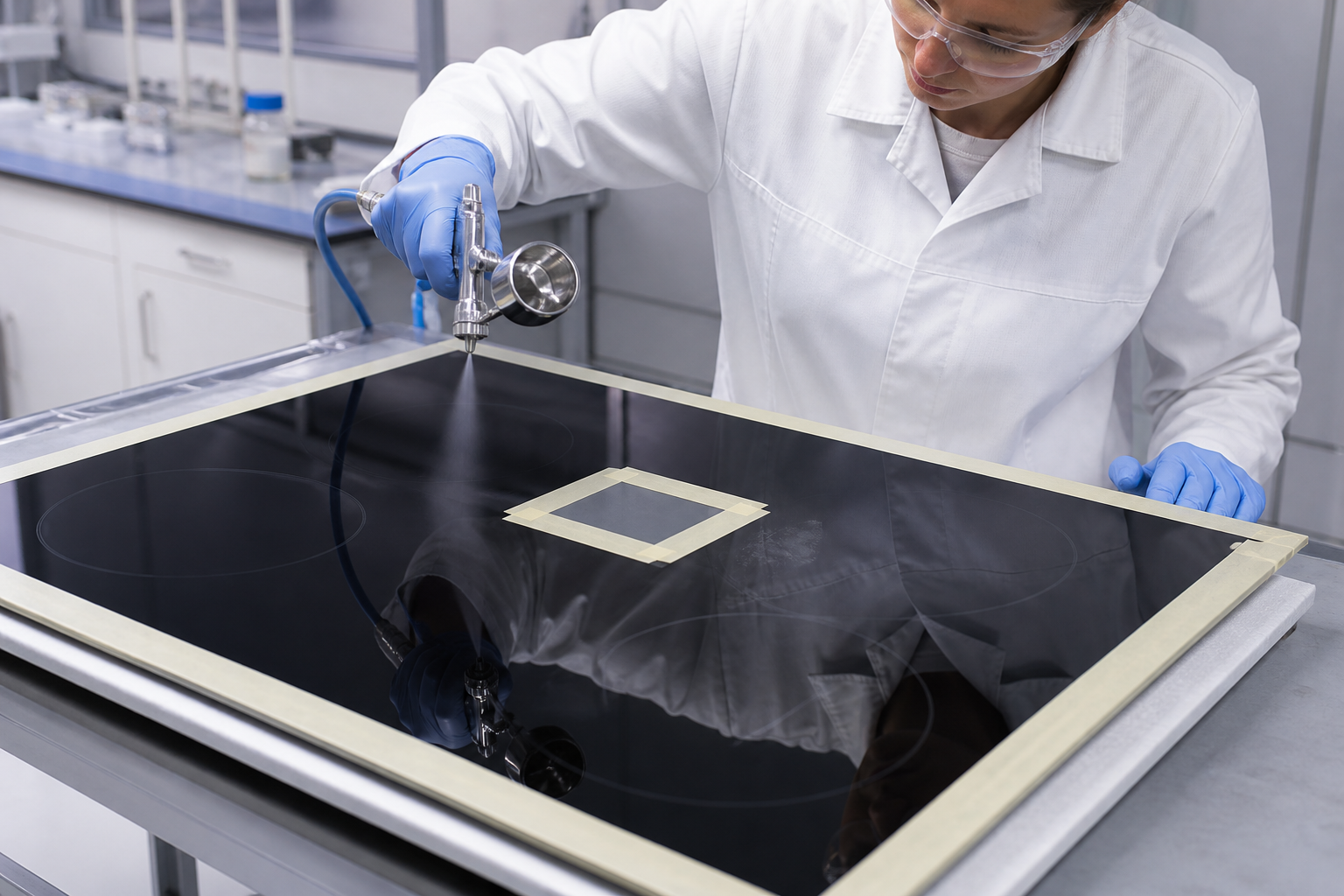
A useful coating specification separates the initial property from retained performance. For example, an initial water-contact-angle target describes the new surface, while an abrasion-and-cleaning sequence followed by the same measurement shows whether the effect survives use. The drawing should also state which face is coated, where the coating must stop, and whether inspection takes place before or after assembly.
Optical requirements need the same discipline. Record the wavelength range, angle of measurement, background, illumination, and whether the acceptance limit applies to total transmission, haze, reflection, color difference, or display readability. A coating that looks clear under office lighting may alter a dark appliance display or create objectionable reflections at an oblique viewing angle.
For qualification, agree on a representative finished panel and a small test matrix: visual inspection, adhesion, wetting or cleanability, abrasion, household-chemical exposure, and thermal cycling. The test severity should come from the actual appliance environment. This prevents a laboratory result on a flat coupon from being treated as proof for a curved, printed, bonded, or repeatedly heated production part.
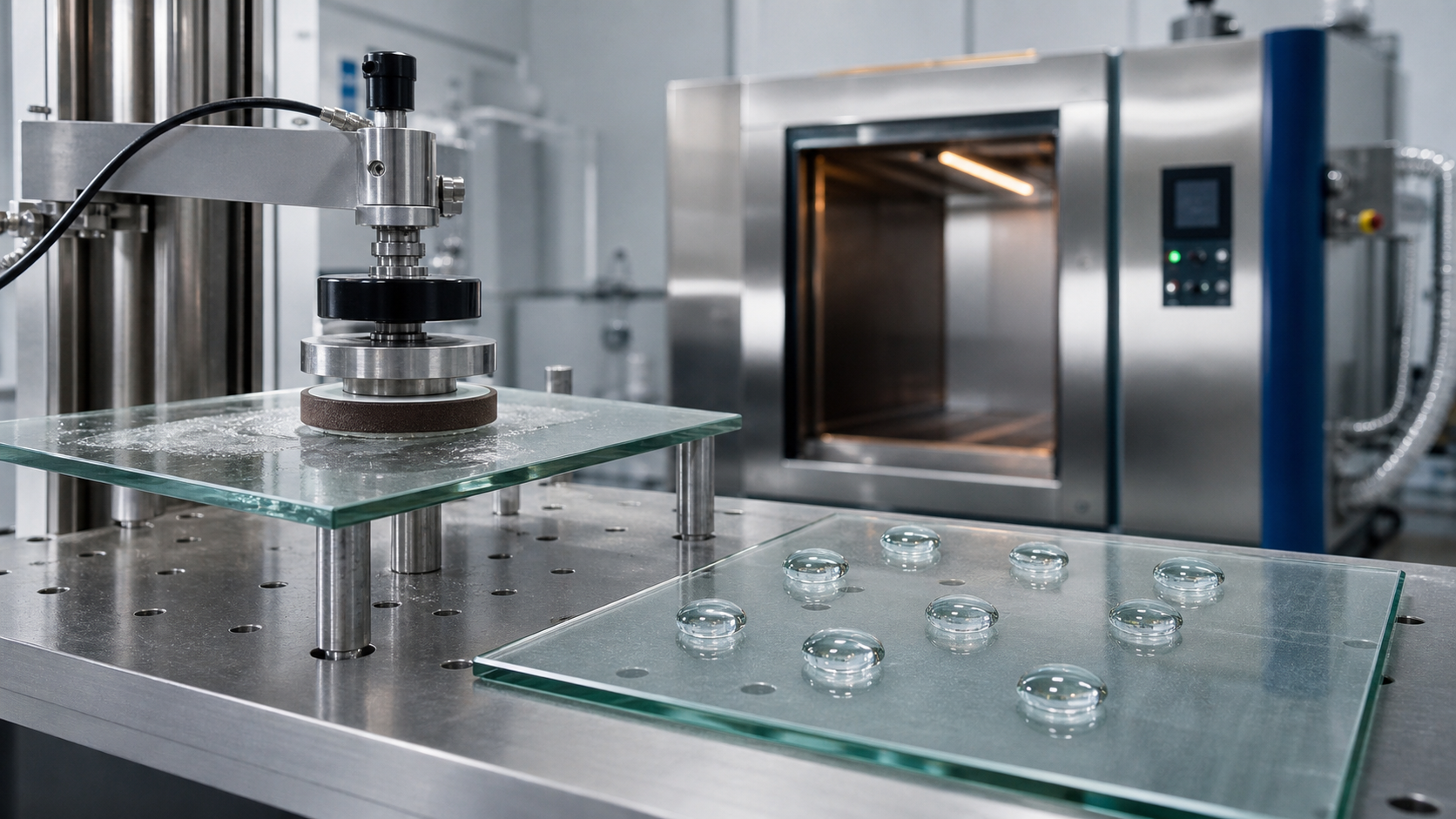
A reliable answer to this topic begins with a decision statement: whether a coating remains cleanable and optically acceptable after real appliance use. That statement prevents a broad material claim from replacing an application-specific requirement. The team should identify the production glass-ceramic panel with the specified print, edge mask, cure, and coated face as the qualification unit. Testing only a convenient coupon can miss interfaces, edge conditions, supports, coatings, seals, or process history that determine whether the finished product works. The approved drawing, revision, test sample, and operating assumptions should therefore use the same configuration.
Build the validation sequence around the damage and variation that the part will actually experience: repeated wiping, approved cleaners, cooking soil, humidity, and the appliance thermal cycle. These exposures should not be selected as impressive numbers without context. Their severity, order, dwell, recovery period, and sample orientation need to be written down. Combined exposure is often more revealing than isolated tests because cleaning can weaken a hot surface, a thermal cycle can change a seal, and handling damage can become critical only after the assembly is loaded.
Record evidence that can be compared before and after exposure. For ceramic glass coating, the useful evidence includes contact angle or roll-off behavior, haze, transmission, color difference, adhesion, and visible nonuniformity. Define the instrument or inspection condition, sample count, acceptance limit, and treatment of borderline results before testing begins. Photographs help with traceability, but they do not replace measurements where a specification calls for a number. Conversely, a single numeric result does not replace a whole-part visual and functional inspection.
The failure review should remain tied to plausible mechanisms. In this case, a strong initial bead effect can disappear after abrasion; coating in a bonding zone can weaken assembly adhesion; a cure change can alter color. When a result fails, preserve the sample and process record, identify where the change began, and decide whether the cause lies in material, geometry, processing, assembly, operation, or the test itself. Repeating the same test without correcting an uncontrolled variable can produce a reassuring result without resolving the underlying risk.
Use staged approval. First confirm material identity and drawing completeness. Next approve a representative first article. Then run the defined durability or service simulation. Finally, verify that production controls can reproduce the qualified part. Approve only after retained optical and cleanability limits pass on the finished construction. Any later change to material source, geometry, surface treatment, thermal recipe, support, seal, or test method should trigger a documented review rather than an automatic carry-over of the old approval.
For purchasing, request a concise evidence package instead of a generic claim. It should contain the controlled drawing, material designation, critical-process statement, inspection method, acceptance criteria, sample or lot identification, and nonconformance path. For engineering, keep a signed master sample where appearance matters and store raw measurements with the report. This makes supplier comparisons fairer, shortens root-cause work, and prevents a marketing phrase from becoming an undocumented safety or lifetime promise.
| Stage | Control | Evidence | Why it matters |
|---|---|---|---|
| Baseline | Uncoated and newly coated finished panels | Optical and wetting measurements under one defined method | Shows the real starting effect |
| Cleaning durability | Approved cleaner, cloth, load, and repeat count | Retained wetting and visible appearance | Separates demonstration from service durability |
| Thermal exposure | Actual panel orientation and appliance-representative cycle | Haze, color, adhesion, cracking, edge lift | Finds heat and interface failures |
| Production control | Surface preparation, coating weight, cure and lot | Control records plus sample checks | Keeps qualified performance repeatable |
Educational video: Bouncing Droplets: Superhydrophobic and Superhydrophilic Surfaces by MITK12Videos. This neutral explainer supports the material or safety principle discussed above; it is not a substitute for the product drawing, appliance manual, or qualification test. Watch on YouTube.
Approval is not the end of the ceramic glass coating qualification process. Record the approved supplier, material designation, drawing revision, manufacturing route, inspection method, reference sample, and test-report identifier in one controlled release file. Purchasing should require advance notice when any of those inputs changes. Engineering can then decide whether the change needs document review, limited confirmation testing, or full requalification. This is especially important when two parts have the same nominal dimensions but differ in glass composition, edgework, coating, thermal history, support, gasket, or packaging.
Incoming inspection should verify the characteristics that can drift or be damaged before assembly, while periodic audits should confirm the properties that cannot be checked economically on every part. Keep nonconforming samples long enough to support root-cause analysis, and link corrective actions to the affected lots and assemblies. A clear deviation process allows a temporary concession only when the responsible engineer has reviewed function, safety, appearance, and traceability. Verbal approval or a supplier’s general datasheet should never silently replace the controlled product requirement.
No. Ceramic glass or glass-ceramic describes the substrate material; a ceramic coating is a layer added to a surface.
No. A coating cannot convert an unsuitable substrate into a high-temperature glass-ceramic. Substrate selection comes first.
Test adhesion, appearance, cleanability or wetting, abrasion, chemicals, and thermal cycling on the finished panel.
Post-coating cutting may damage the layer and edges. Complete geometry processing in the supplier-approved sequence.